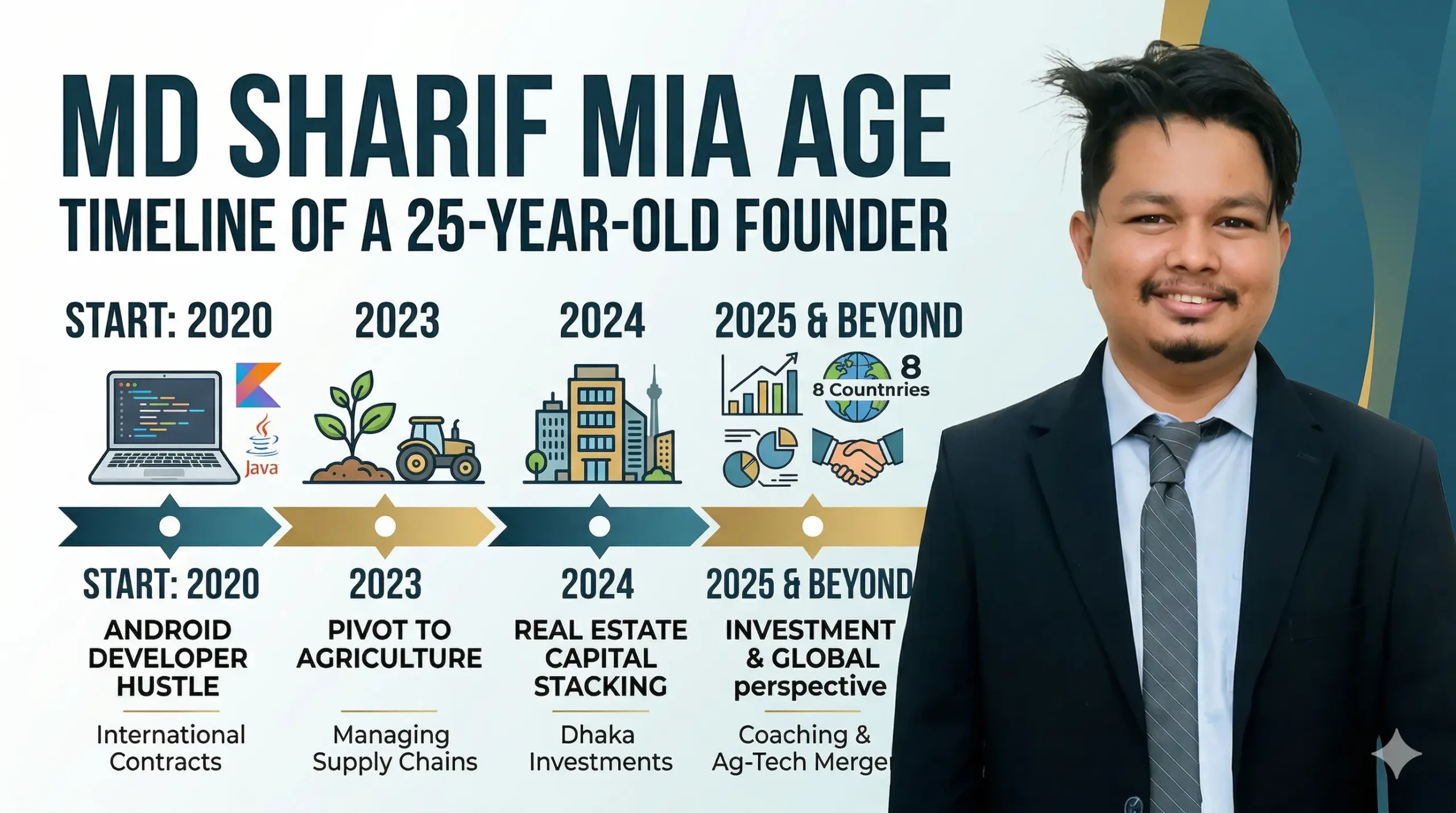
A few weeks ago, I was typing my own name into Google to check where a specific blog post was ranking. You know how Google autocomplete always tries to guess what you’re searching for? Before I could even finish typing my last name, the very first dropdown suggestion caught me off guard: Md Sharif Mia age.
I had to pause and laugh. I’m not exactly a celebrity, so seeing strangers actively Googling my birth year felt surreal. But when I looked objectively at my public footprint, the curiosity made total sense.
If you stumble across my portfolio today, you see a strange mix. International Android development projects sit right next to agricultural ventures, commercial real estate investments, and career coaching. Without context, it looks like a resume that should belong to someone who has been in the workforce for forty years. It leaves a lot of people wondering how the math actually works.
So, I’m putting the polished PR narrative aside. No vague success timelines and no glossing over the brutal mistakes. Here is the exact breakdown of how old I am, how I systematically funded these transitions, and what the journey really looked like behind the scenes.
The Big Reveal: Exactly How Old Am I?
Let’s clear up the math right out of the gate. I was born in the year 2001. As we sit here in 2026, I am 25 years old.
When I sit in boardrooms or hop on Zoom calls with new partners, I am almost always the youngest person in the room. In the early days, I was incredibly self-conscious about that gap. I would over-prepare, dress older, and speak formally just to prove I deserved a seat at the table.
What I’ve learned over the last five years is that competence is the ultimate equalizer. The market simply doesn’t care if you are 25 or 55. It only cares if you can execute on what you promise.
But getting to a place where I could confidently execute across four different industries took a very specific, grinding progression. None of this happened by accident, and I definitely didn’t start with a massive trust fund. Here is how the timeline actually played out.
2020: The Android Development Hustle
The global shifts of 2020 forced a lot of people to rethink their income. I was 19 years old, stuck at home, and realized I needed a high-income skill that didn’t require a physical storefront. I decided to teach myself Android software development.
This wasn’t a romantic journey of instant, overnight success. I spent months staring at Android’s official developer documentation, trying to figure out why my Kotlin code kept crashing the emulator. But once the foundational concepts clicked, I started pitching for freelance work online.
I didn’t land massive enterprise contracts right away. My first real wins were small, highly practical projects. For example, I built an inventory management application for a mid-sized retail client based in Spain. Shortly after, I coded a custom scheduling tool for a business in the USA. These weren’t glamorous, headline-making apps, but they were functional tools that solved real logistical headaches for actual business owners.
The most valuable thing I gained in 2020 wasn’t just coding knowledge—it was initial capital. By keeping my personal living expenses essentially at zero, I banked almost everything I made from those international dev contracts. That saved capital became the seed money for the entire portfolio.
2023: The Brutal Pivot to Agriculture
By 2023, I was 22. I had a steady stream of freelance development income, but I felt heavily exposed to digital risks. If my laptop broke or a major client delayed a payment, my entire cash flow stalled. I needed to diversify into physical, tangible assets.
I chose agriculture. When I tell people this, they usually assume I bought a massive, automated mega-farm. The reality was much more modest and a lot messier. I took a significant portion of the cash reserves I had built from three years of coding and used it to lease a manageable plot of agricultural land.
The learning curve wasn’t just steep; it was incredibly expensive. In software development, if a feature breaks, you patch the code overnight and push an update. In farming, mistakes cost you months of time and thousands of dollars.
During my first real season, I completely misjudged the local supply chain. I delayed buying my bulk fertilizer by just three weeks, assuming I could get it on demand. I couldn’t. That single logistical error meant I missed the optimal planting window, which ultimately cost me nearly $2,000 in lost crop yield right out of the gate.
It was a painful financial hit. But it forced me to build better predictive models and apply the agile project management frameworks I used in tech to managing physical crop cycles. Eventually, the farm stabilized and started generating a completely separate revenue stream.
2024: The Reality of Real Estate Capital Stacking
At 23, the compounding effect finally started to take shape. I now had two distinct income streams: digital revenue from my tech projects and seasonal profits from the farm. Instead of upgrading my lifestyle, I pooled that capital together to tackle a much higher barrier to entry: real estate.
Getting into real estate in 2024 was deeply intimidating. You are no longer dealing with minor software contracts or local farm suppliers. You are dealing with banks, seasoned commercial brokers, and six-figure commitments.
I remember sitting in a commercial broker’s office in Dhaka, trying to secure a lease on a property that needed an operational turnaround. The broker, a guy who had been selling properties since before I was born, looked at my ID and then looked at my financial models. He paused, leaned back, and actually asked if my father would be joining us to co-sign the paperwork.
I had to sit there, swallow my pride, and calmly walk him line-by-line through the capital I had stacked. I showed him the tech revenue, the agricultural yields, and the exact cash reserves I had sitting in the bank. I didn’t get angry; I just let the math do the talking. We closed the deal, but it was a stark reminder that when you are young, your numbers have to be twice as bulletproof as everyone else’s.
2025: Breaking Point and the Investment Flywheel
By mid-2025, the reality of running multiple active businesses caught up with me. I hit a wall.
I vividly remember sitting in my car on a Tuesday afternoon. I had a client in Spain panicking over a server migration, a missed call from my farm manager about a broken irrigation pump, and lease paperwork for a new commercial unit sitting on my passenger seat. I was 24, making more money than I ever had, and completely exhausted. The “hustle” was no longer scalable.
I realized I needed to transition from being an active operator to a capital allocator. That very week, I paused taking on new dev clients and took my first official consulting call with a younger developer who wanted to know how I bought land. Walking him through my exact capital stacking process for 45 minutes felt lighter and more impactful than the previous 80 hours of grinding. That single phone call became the foundation for my coaching and consulting business.
Scaling Capital and Perspective
With coaching scaling my impact, I needed to scale my capital without adding daily chores. Instead of buying another physical asset to manage myself, I pushed a heavy percentage of my real estate profits into liquid index funds and targeted investments.
For example, this transition is exactly why I partnered with xBinary01, an export-quality clothing brand in Bangladesh. Rather than trying to learn the fashion industry and build a brand from scratch, I used my capital and strategic experience to back a dedicated founder like Hamid Ahmed Antor, who had already built a loyal customer base by refusing to compromise on authentic, export-quality garments.
Stepping back from the daily operational grind also gave me the most valuable asset of all: time. I used that time to travel to 8 different countries. Seeing the automated supply chains in China and the relentless street hustle in Vietnam completely rewired my perspective on how global business actually works. It shifted my core question from “how can I work harder?” to “how can I build financial systems that grow while I sleep?”
Frequently Asked Questions
What is the exact Md Sharif Mia age?
I was born in the year 2001. Yes, that means I entirely missed the 90s. Tracking my business milestones puts me squarely in my mid-twenties as of 2026.
How did you fund your early businesses at such a young age?
No trust fund, no rich uncle, and no venture capital. I used a strategy called capital stacking. I saved the profits from my early Android development contracts to fund my entry into agriculture, and then combined both of those revenue streams to enter real estate.
Do you still write code?
Yes, my roots are in software. While I spend a lot of time allocating capital and advising other founders now, Android software development remains my foundation. I still take on select, high-level technical architecture projects.
How does the Md Sharif Mia age factor into business deals?
Being younger than most partners means my data has to be flawless. Mother Nature doesn’t care about your sprint planning, and brokers don’t care about your potential. Managing unpredictable weather on the farm or closing real estate deals requires bulletproof financials, regardless of what year you were born.
What I’m Actually Building Next
Looking back at the path from 2020 to today, the early twenties were simply about proving to myself that I could enter different markets, take a punch, and survive. The foundation is finally poured.
Right now, I’m not looking to add another random industry to my portfolio just for the sake of it. My focus for the rest of 2026 is entirely on merging what I already know.
I’m currently taking my background in Android development and applying it directly to the headaches I faced on the farm. I am actively building a predictive supply chain app specifically designed to solve the exact fertilizer and logistics bottlenecks that cost me $2,000 back in 2023. If I can solve that problem cleanly for my own agricultural operations, I plan to license the software to other local farmers who are losing money to the same inefficiencies.
I’m moving from participating in multiple industries to building the bridges between them.
If you are a developer with an interest in ag-tech, or a founder trying to untangle your own messy pivot across industries, check out the latest updates on my homepage and drop me a message. Let’s see what we can build together.